I’ve no idea why I booked this weekend “course”. Before I had children I enthusiastically embraced the biodynamics osteopathy programme. I attended many phases of the curriculum, hoping that if I did enough I would finally figure this damned thing out! Children intervened around phase 4 or 5, and twenty years later the small ad for Biobasics winked at me like a half-forgotten old friend from the pages of an osteopathy magazine. It sounded like Biodynamics Lite. An affordable 14 hours CPD in London, over an Autumn weekend. Well, I’ve given up expecting to “figure it out”, or even to be much good at it, and this time all I was after was a refresher in deep palpation and a mini-break to soften the sad demise of an incredible Summer.
Nick Handoll, former osteopath, opened the proceedings with a bit of science. Pointing out that Newtonian Physics doesn’t work at extremes, he told us that he had been advised to “read quantum mechanics” by Rollin Becker, one of the pioneers of cranial osteopathy. He pointed out, as if I needed reminding, that we are limited beings. Our human cortex does not actually have the ability to understand reality. He also helpfully gave us his definition of osteopathy:
Osteopathy (according to Nick Handoll) is:
A Philosophy of Healthcare Concerned with That which Compromises Health
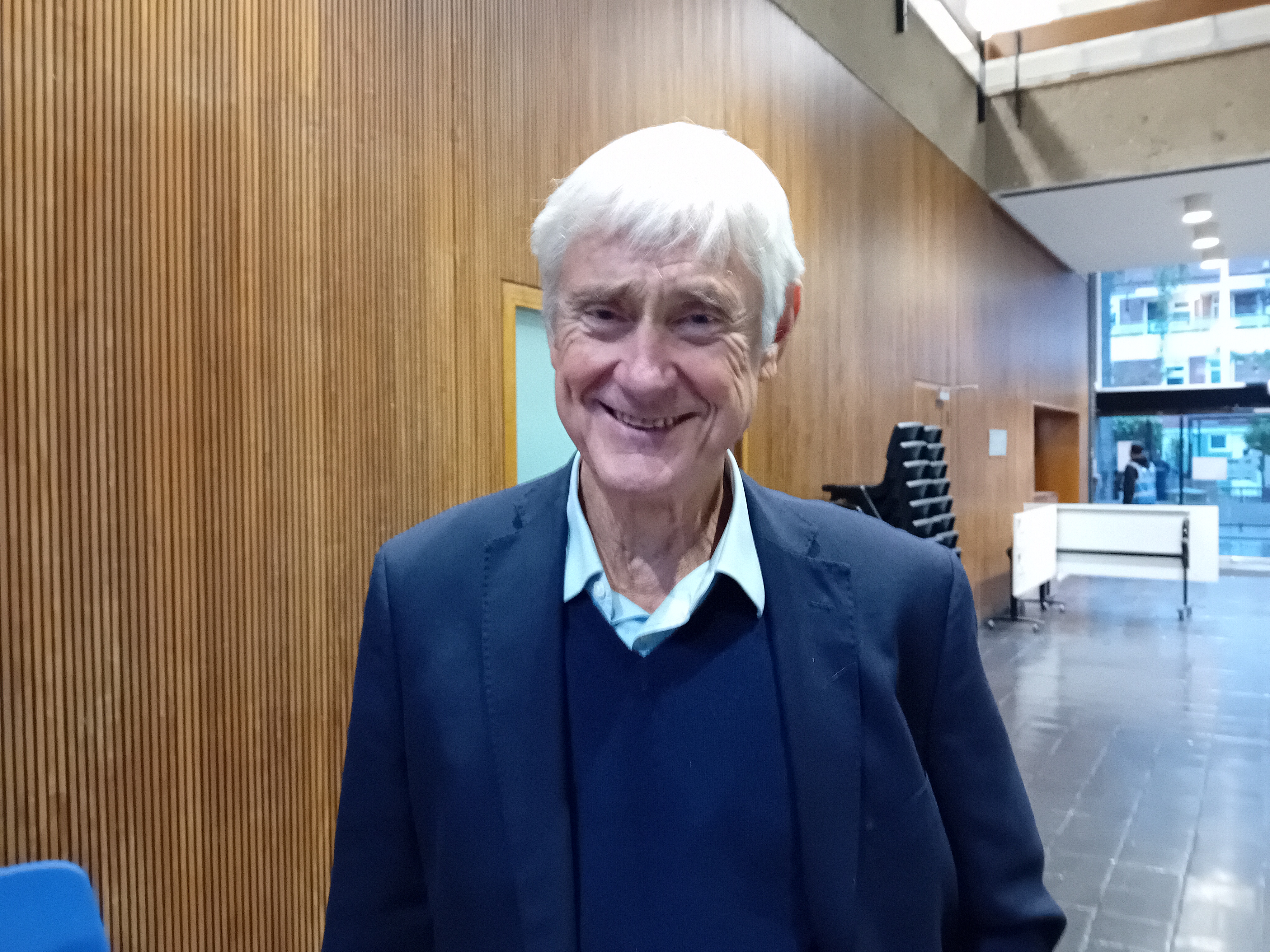
Nick Handoll shared his experience, his thoughts, and his twinkly smile
What we do as osteopaths, he said, is to ask why the body hasn’t been able to sort out the problem itself. This is different from the medical approach, which asks not why things aren’t right, but rather what has gone wrong. He emphasized the importance of taking a good medical history. He pointed out that palpation is essentially a relationship between one living organism and another in which we connect via our hands but experience through our souls. Through palpation we can become aware of disharmony, discomfort, lack of ease. The patient can be emotional, off balance, twisted, tight, stiff, clogged up.
Then he moved back to science. We are living in a sea of electromagnetic radiation, he said. This primordial background radiation permeates the universe smoothly and evenly and has been there since the year Dot. It is constant, calm and reliable – an inseparable web of vibrating energy patterns. Well, this was a hell of a keynote introductory speech. A bit more than I’d bargained for.
I think I did experience some kind of universal energy field once, but only once. I was, at the time, heavily immersed in the writings of Ouspensky and Eckhart Tolle, and zealously and conscientiously practising mindfulness morning and evening and any time I remembered in between. As I walked down the hill from the corner shop one afternoon, I unexpectedly felt myself merge with everything, cease to exist as a separate entity, and feel in a deeply calm and enlightened state in which “I” no longer existed. This lasted several seconds, and felt sublime. But despite being a powerful experience, it was not really enough to start my own cult, and remained stubbornly resistant to being reproduced, despite my best efforts. But still, I thought, maybe this was the kind of thing Nick was getting at.
He then recommended us a couple of scientists to read:
Carlo Rovelli, who writes the sort of books I wish I could understand. If only physics was not my weakest subject! Titles include Quantum Gravity, Reality is not What it Seems, White Holes, The Order of Time, and, my personal favourite, There are Places in the World where Rules are Less Important than Kindness. Rovelli inhabits that strange space in which physics and philosophy often meet, and Nick shared with us this rather Shakespearean quote from him:
And it seems to me that life, this brief life, is nothing other than this: the incessant cry of these emotions that drive us
Iain McGilchrist, Cambridge psychiatrist and philosopher, was the other scientist he told us about. He wrote about the divided brain in The Master and his Emissary. I think I have seen it on the Waterstones science table. McGilchrist apparently claims that the primary function of the corpus callosum is to inhibit the other side of the brain. One hemisphere alone, he says, can yield a coherent system of the world. To simplify, the right side sees the big picture, not the detail. The left side, which he says is dominant in our society, sees the minutiae. It is analytical, overconfident, has to be in control and lacks insight or self-criticism. It cannot understand the right side of the brain, but is reluctant to admit it can’t understand.
The attention we pay to the world, Nick said, is our creative act. Ignorance of ignorance is the death of knowledge. By this time, I was really losing the ability to follow, but I did realise that the weekend might be all about switching off the left side of my brain and inhabiting the right. Yes, we were here to see the bigger picture. We were large-ing it up at Biobasics 2026!
The weekend is beautifully paced with a spacious rhythm. Lecture, practical, coffee, lecture, practical, lunch, lecture, practical, tea, you get the drift. We were in a school hall filled with treatment tables. We paired up for the day, and each pair had their own tutor. Yes indeedy! One whole tutor to ourselves for the entire weekend. How do they finance this, I wondered, considering the very reasonable price point. Well, the tutors are all volunteers. Yes, it’s the kind of event people love so much they want to work for nothing. Amazing.
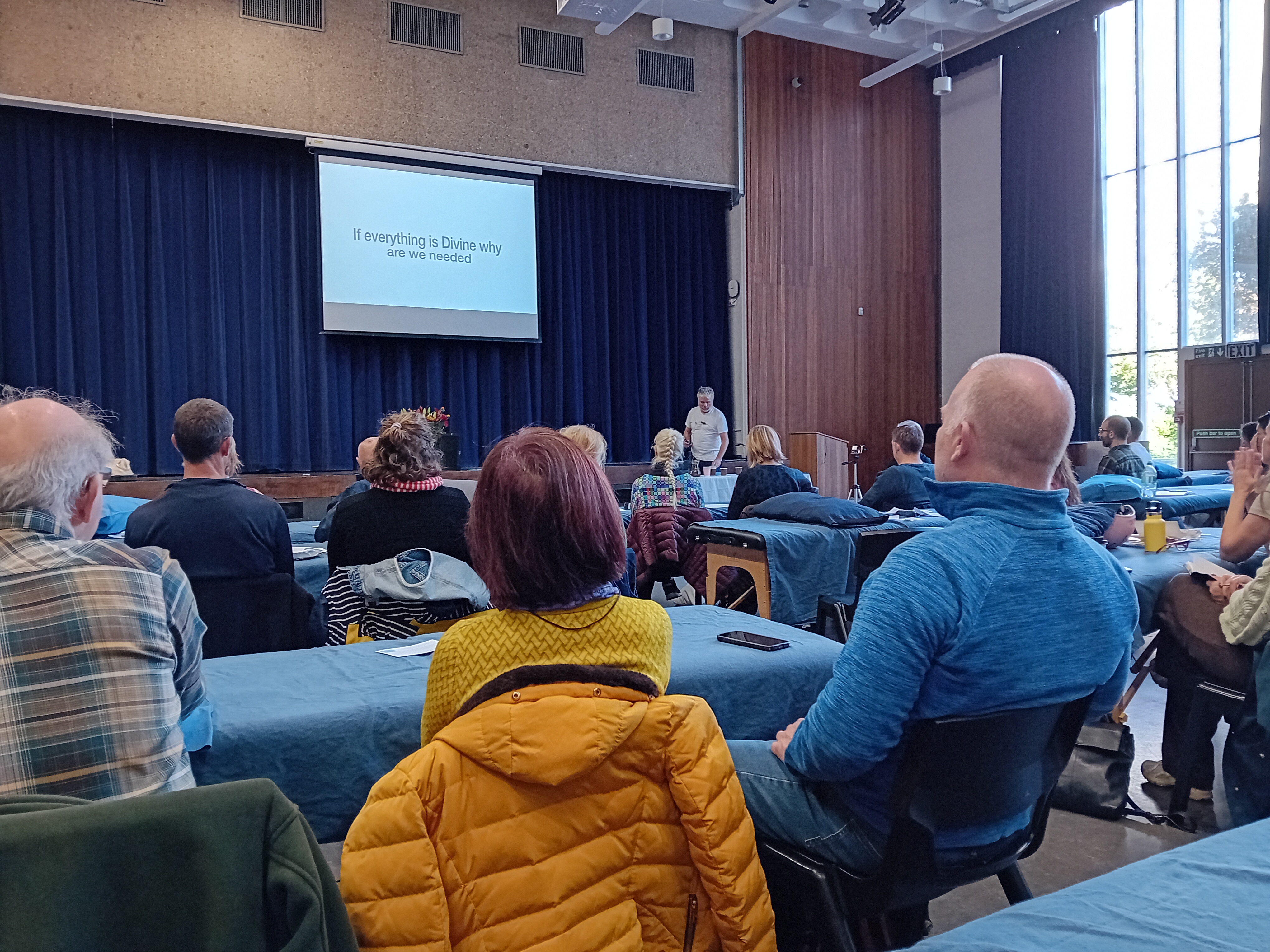
There must have been 25 treatment tables – so that made 25 pairs plus tutor, plus assorted oddbods and organizers scattered round the edges. It must have made the number present up to somewhere around 100. There was a good mix of newcomers and old timers, and the event is even open to students. Someone told me it was the fastest growing CPD in osteopathy.
The practical sessions were not about learning a new array of techniques to take back into practice. Less is more in the biodynamics field, and this introductory weekend seemed to be more about the effort to not do anything, about maintaining a certain state of attention, in which we tried to observe without acting, to allow rather than to do. Not as easy as it sounds when you’ve got in the habit of hunting round the body for problem areas to fix. But we did our best.
2nd lecture was from Jo Piercy, who made an impassioned plea for more support for mothers in childbirth, especially those who were low risk, and didn’t need assisted birth. She wants birth to be properly honoured as a sacred rite of passage, for mothers to be taught about informed consent, and she reinforced on us the importance of listening to birth stories.
Another practical followed in which I again did my best to maintain the meditative type of state which stops you pouncing on a lesion, and I again had to tell my partner that I never feel anything when I have cranial myself. (I hate to disappoint but it’s the way I’ve always been – I feel the effects later.) Then it was lunch, so I thought I’d head out to find my hotel in the light.
I used to have friends in Hackney, in the 1990s. It was the kind of place you visually scanned a 50 metre radius before getting out of your car. But times have changed, and as I google mapped my way to the City Express Inn I was pleasantly surprised. It’s all well-designed green spaces, craft beers and flower markets now. I saw quite a lot of the area as I kept going in the wrong direction (what was ever wrong with an A to Z? At least you knew where North was). Finally I found it. On a nearby corner there was a stand offering free Hep C testing and information about “What’s In Your Drugs?”. Well, reassuring to know that gentrification hasn’t destroyed the entire character of the area!
Back that afternoon, we plunged into the glymphatic system with Catrin Mear. She explained that pre-2012 we did not really know how CSF (cerebrospinal fluid) and waste from the brain were cleared. The glymphatic system is a proposed pathway by which CSF exchanges with cells. This system varies with sleep, and is thought to be more active during deep, non-REM sleep, in which there are low frequency delta waves. She referred to a very interesting paper on fluid transport in the brain by Rasmussen et al. (2022).
Another practical followed in which I tried very hard not to do anything. How to explain this? Rather than charging into a woodland and tramping about looking for birds and badgers, instead you just sit somewhere very still, try to be invisible, become part of the wood, observe patiently, and wait for the wildlife to emerge. I guess birdwatchers are naturals at this. As an impatient person, and as someone who is conscious that patients often want you to “do” something, this is really not as easy as it sounds for me. At some point, though, with the guidance of my wonderful tutor, I did somehow pick up that my partner’s body felt it had sort of expanded beyond the physical. A strange sensation. But I was encouraged to go further. More patience, and more help, and next thing not only the patient expanded, but with a definite kind of “click”, somehow felt more merged with the room. Incredible stuff. Subtle but entirely tangible.
Last lecture of the day was Christian Sullivan, who pleasingly had remembered who I was and greeted me with a big, warm bear hug on my arrival. When I began doing the phases, it seemed to me that Christian WAS the UK branch of Biodynamics. It’s amazing what he has generated through years of dedicated effort, and he would be the first to pay tribute to all the others who have come before, alongside and after him. He is not taking the phases in the UK himself any more. That honour now goes to Richard Metliss of Shire Biodynamics, in the charmingly named Church Stretton in Shropshire. Richard was closely connected with Jim Jealous, the pioneer of the Biodynamics approach. And for this event, huge thanks go to Hazel, Fabiano and Janice.
I slept well Saturday night, and was back bright and early for the first lecture of the day from David Cooke. Fittingly for a Sunday morning it was an inspiring and somewhat reverential overture, complete with quotes from spiritual leaders such as Rumi (“You are not a drop in the ocean. You are the ocean in a drop“), and Thomas Merton (“Life is this simple: we are living in a world that is transparent and the divine is shining through it all the time“). Then another practical, in which I tried to do nothing as a practitioner and felt nothing as a patient, except nicely relaxed.
Marion J Gill then joined us remotely from Majorca. She took us back to brain waves, talked about Les Fehmi‘s concept of the “Open Focus Brain“, in which you widen your attention. How wide? Well, apparently Jim Jealous recommended focussing on infinite space. A bit of a mindbender, this concept. She also told us that the heart is not only a kind of a pump, but also a sensory organ and its electromagnetic field is much larger than the brain’s. At this stage of the weekend I really needed to take a handout away with references to examine later.
In the practical, I really tried to widen my focus. I thought of my attention as being like a light. Often I am narrow focussed, like a laser, scanning around the body – this segment, that muscle, this tendon. But I widened this light out, at first to a kind of torch, still somewhat darting about, illuminating smallish areas. But then I expanded it more, it became a larger torch, like one you hang in your tent when you’re camping, and finally, as best I could, my attention was just a soft, diffuse light, spreading out everywhere, a bit like the coming of dawn, I suppose, and just encompassing my partner’s body, and even my own, as part of the entire field.
Lunch happened, fancy bagels and lattes bought and quaffed, and then the last lecturer was the wonderful Mary Bolingbroke. With a name like this she must surely be descended from mediaeval royalty, and indeed she reigned over the room with the elegant, commanding presence of a divinely-appointed sovereign. She showed us a picture of a gingerbread man. This represented our soul. We are all cut out of the same cookie dough. She talked about field theory, entanglement, streams of fluid, the composition of fascia, macrophages, trauma, shapes, peptides, reorientation. I stopped taking notes and just let it wash through me. She urged us to let go of our self-importance, and our self-doubt, to switch our brains off and our hearts on.
Ok, last practical before my dash to Hoxton Station. I was ready to go home, really. Busy week ahead! Already planning all the things I had to get ready when I got back. Down I lay on the couch. I always quite like the post lunch cranial sessions! Before I knew it, I felt that I was drifting off. Unbidden, I saw an image of a large open yellow flower, made from paper, with lots of cells, a bit like a Chinese paper lantern. What a nice image, I thought. It stayed.
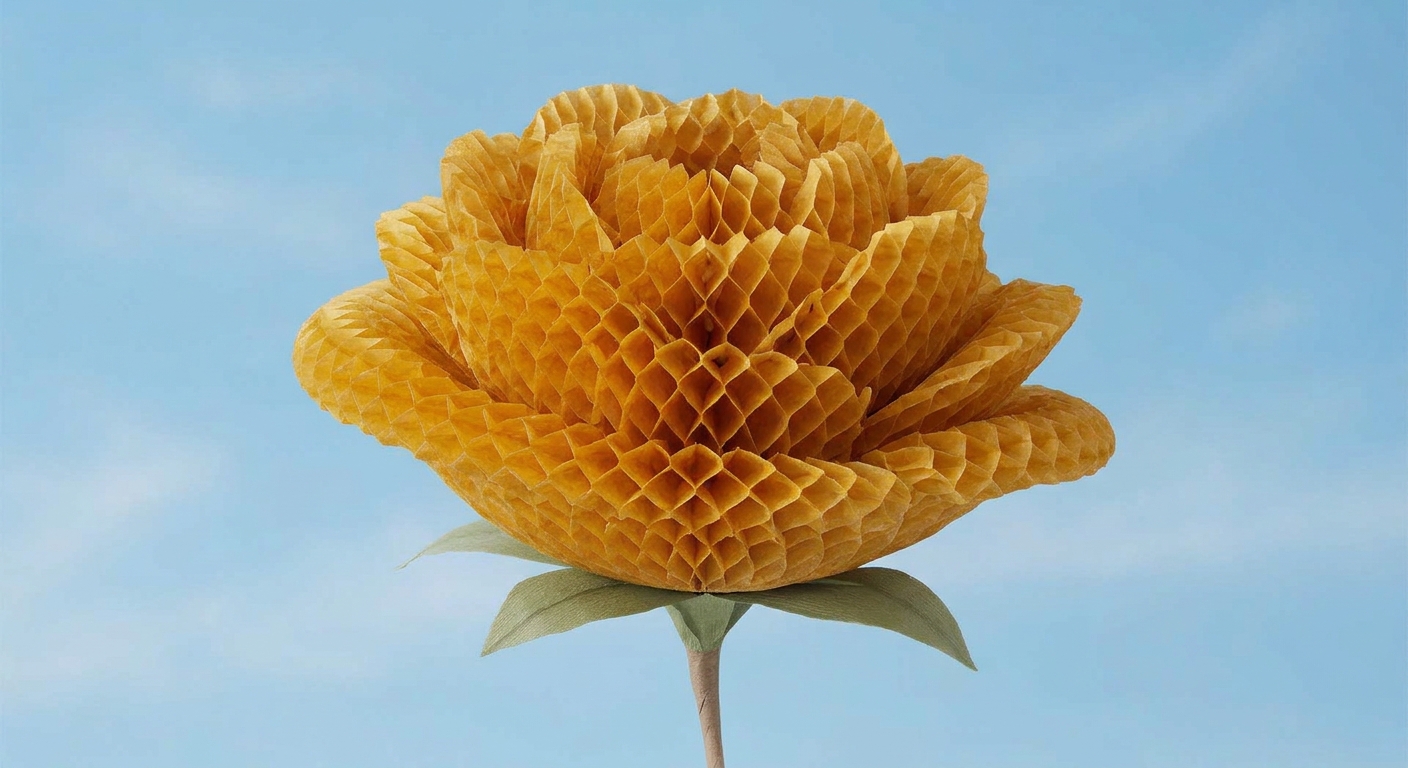
It looked very much nicer than this, but as we’re all discovering, AI has its limitations
Next thing, into my head popped a green, living stem and bud. Not opened yet. But it was new life – intriguing, fresh, natural, real. It wasn’t a detailed image, but somehow very nourishing. These images seemed to be feeding me feelings. Deep, pleasant feelings. I was luxuriating in these nice sensations – the flower, the bud – when I suddenly felt a whoosh! I had that moving-in-a-lift feeling, where you’re not quite sure if you’re going up or down. Then I was looking down on a beautiful, green landscape, the type of thing you imagine seeing from a hot air balloon, in a children’s book – cute little bridges connecting different fields.
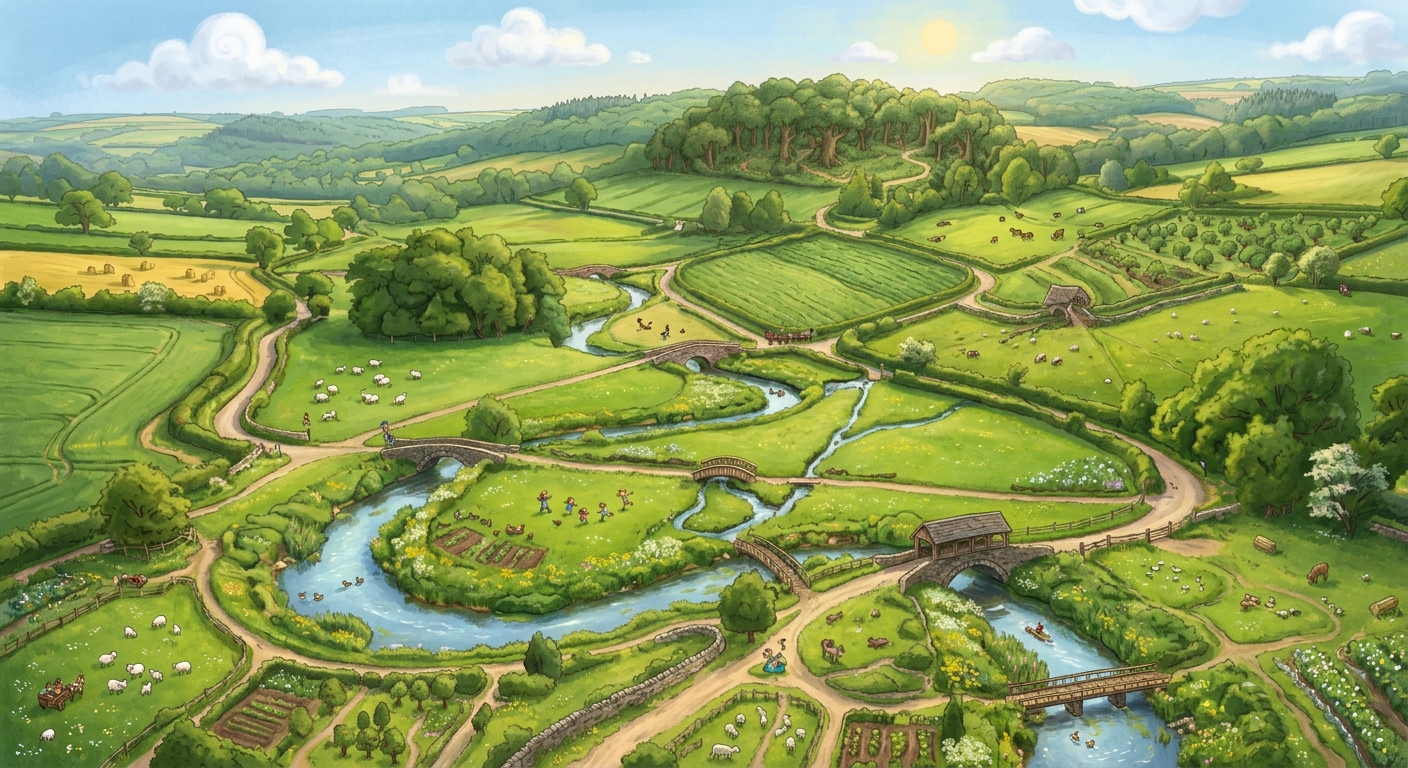
I like to think this is something about my wish for osteofm to bridge all the different parts of osteopathy
Was I awake? Was I asleep? Was it a dream? I wasn’t really sure. I could hear everyone talking, and I knew where I was, but I was definitely seeing, and feeling, vivid images that I wasn’t deliberately generating. The practical ended and I woke up? Came down? Came to? I wasn’t quite sure how to classify these different levels of consciousness. Sparkly-eyed, I sat up, excitedly blurting out “That was incredible”. Somehow they knew. I started to babble on about the yellow flower. “Save it for after” said my tutor. It was my turn now to treat, or not treat, as the case may be.
Well, I rested my partner’s head on my hands, and looked out at the sky. And sat. And waited. Could the day be more perfect? A flock of birds flew into view, curved around, and flew away. The parabola they made was so beautiful, so right, that I couldn’t imagine any choreographer could have designed it. It almost seemed preordained, as if they were following an arc in a dense, yielding medium. The world wasn’t just beautiful. It was perfect. And everything was just as it should be.
Hmmm. I can see why they call this the Glastonbury of Osteopathy
We finally wrapped up. I shared my experience, uttered profuse thanks to my partner for such a blessing, and made for home. Sitting at East Croydon an hour later, I perched on the window seat of Caffe Nero, sipping hot chocolate and drinking in the sweet, sweet milk of human kindness which I saw shining out of the people walking past. Even the old woman, bent over, dragging her shopping trolley, with her bad haircut and old clothes and triple chin, had a dignity and rightness and beauty about her. How lucky, I am, I thought, to experience this. (N.B. this is not my usual state of mind on a chilly Sunday evening layover, waiting half an hour at East Croydon for my connection.)
So that was it. Biobasics 2026. A great success. Highly recommended, although I can’t promise you’ll have the same in-body out-of-body experience that I did. But, like me, you might find that when you get back into your clinic room, you give yourself, and your patient, a little chance to rest, and regroup. You might find you can hold off charging around finding and fixing lesions like a distracted rhinoceros, even if just for a few minutes.
Thanks for reading, as ever.

